Roughly half of respondents are testing or have implemented AI for improving company and process efficiency, and about the same share for improving customer experience. But when asked about generating revenue using AI-powered products, only 20% were testing and 13% had implemented anything at all.
So the honest reading of 87% is this: almost everybody has AI somewhere in the building, and almost nobody is selling anything with it. It is being used to do existing work with fewer hours, which is a perfectly good reason to use a tool and a very different claim from the one the number implies.
What it is actually being used for
A separate survey of event organizers breaks the usage down by function, and the shape of it is telling.
| What organizers use AI for |
Share |
|
| Data analytics | 20% | |
| Personalization | 18% | |
| Content creation | 15% | |
| Customer service automation | 14% | |
| Event logistics | 12% | The smallest slice with the clearest payback |
| Matchmaking | 10% | |
| Security | 5% | |
The same survey found 45% of organizers actively using AI, 30% of those having started within the previous twelve months, and 65% planning to increase usage over the following one to two years. Around 70% describe the impact positively. The barriers are mundane rather than philosophical: staff training at 30%, cost at 25%, data privacy at 20%, integration difficulty at 18%.
Notice what sits near the bottom of the usage list. Event logistics, at 12%. That is the category where the costs are largest, the pricing is most opaque, and the work is most repetitive — which makes it the category where automation has the most obvious arithmetic and the least attention.
Why the boring half matters more this year
There is a reason cost-side automation is landing harder in the United States than the revenue-side kind.
The same UFI research found that only 8% of US companies expect operating profit to grow by more than 10% in 2026, well below the global picture. An industry that is not confident about growing revenue gets very interested in not spending as much.
Then there is fuel. US average on-highway diesel hit $6.285 a gallon in the week ending 14 September 2026.
| Week ending |
US average |
Change |
| 31 August 2026 | $5.599 | — |
| 7 September 2026 | $5.967 | +36.8¢ |
| 14 September 2026 | $6.285 | +31.8¢ |
That is a 69-cent move in a fortnight, on the fuel that every piece of trade show freight runs on. Fuel surcharges are indexed pass-throughs, so they rise on their own whether or not anybody negotiates anything. When an input moves like that, the levers you still control get a great deal more valuable.
Where AI has actually landed in graphics production
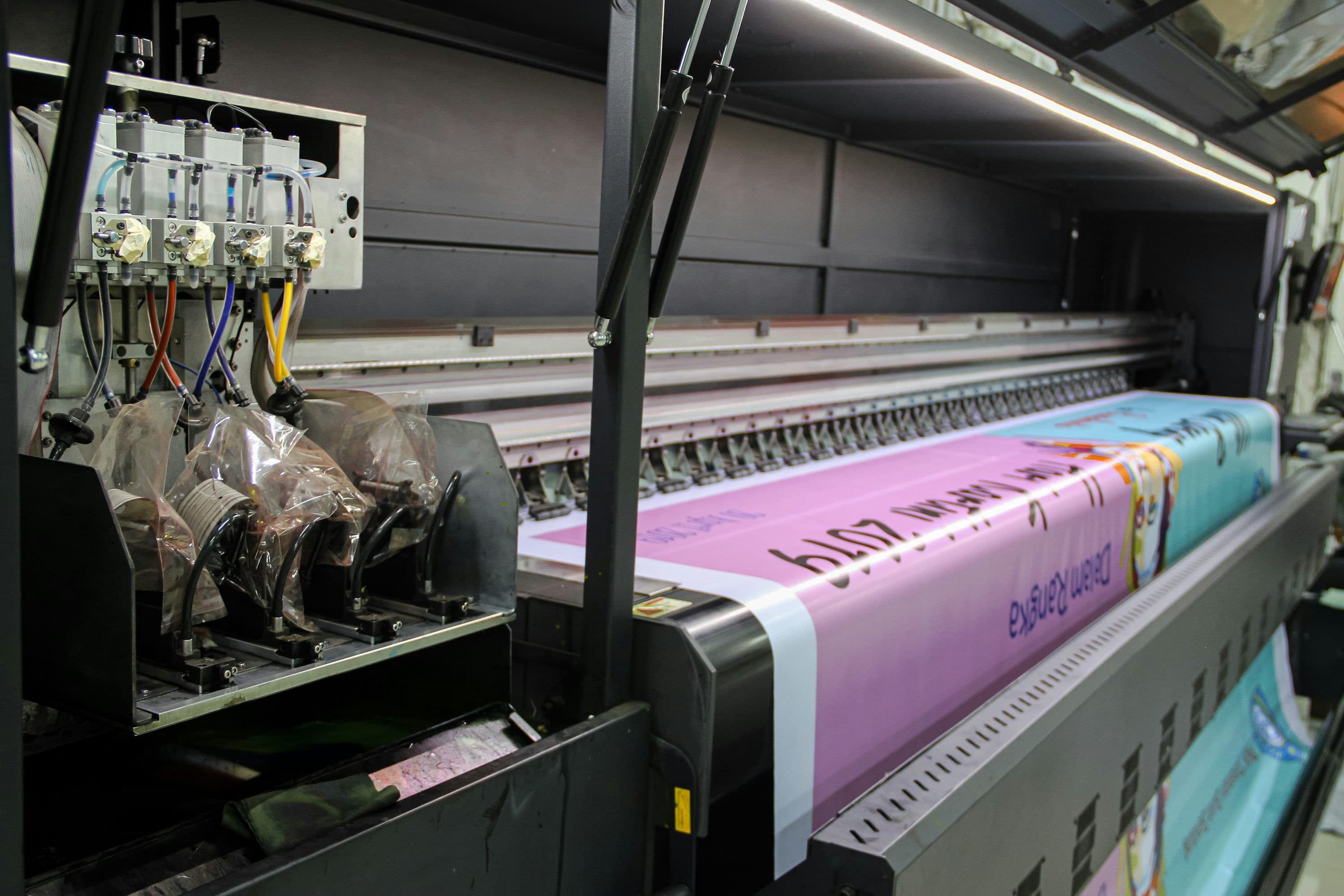
Look at what a large format graphics operation actually does all day and it becomes obvious why this is fertile ground. A booth graphics job arrives as customer artwork of wildly variable quality, gets checked, corrected, colour-managed, laid out to minimise material waste, printed, finished and shipped — and most of the checking and correcting has historically been a skilled person looking at a file.
The tools now shipping in wide format target exactly that sequence:
- Automated preflight and file preparation. Files are checked and prepared on arrival rather than by an operator opening each one, which removes the defensive habit of hunting for problems by hand.
- AI image processing. Brightness, contrast, sharpness and background removal — the Photoshop work that used to precede every print — handled automatically to a print-ready result.
- AI-driven imposition. Laying jobs out on the material. This one is directly financial: on wide format substrate, layout efficiency is material cost.
- Workflow analytics. Systems that read production data and surface bottlenecks and recurring faults, instead of somebody noticing a pattern six months late.
- Installed-graphic validation. Checking an installed graphic from a photograph for wrong placement, missing elements or mounting defects.
What is striking about that list is what is not on it. None of it generates artwork. The value is in removing manual touchpoints between a customer's file and a correct print — and the vendors building these tools are explicitly aiming them at small and mid-sized shops rather than industrial printers, on the argument that automation no longer requires major capital.
For an exhibitor, the effect worth caring about is turnaround and reprint rate. A shop that catches a bad file on arrival rather than after it prints is a shop that misses fewer deadlines, and in graphics the deadline is usually the whole job.
The economics look different again inside a captive graphics operation — one that prints for exhibit programs rather than for the open commercial market. Factory of Graphics runs that way out of Orlando and Las Vegas, and works through weekends, because its production calendar is somebody's install date rather than a delivery window. When prepress sits upstream of a show opening instead of a shipping cutoff, catching a bad file on arrival is not an efficiency gain. It is the difference between a booth that opens and a booth that opens with a blank wall.
That is why the question of what to automate is live across the sector right now, and why it is being decided on economics rather than on technology. The tools have stopped requiring the capital they used to.
Where AI has landed in freight — and what it really does
The more interesting case is the one nobody puts on a conference agenda.
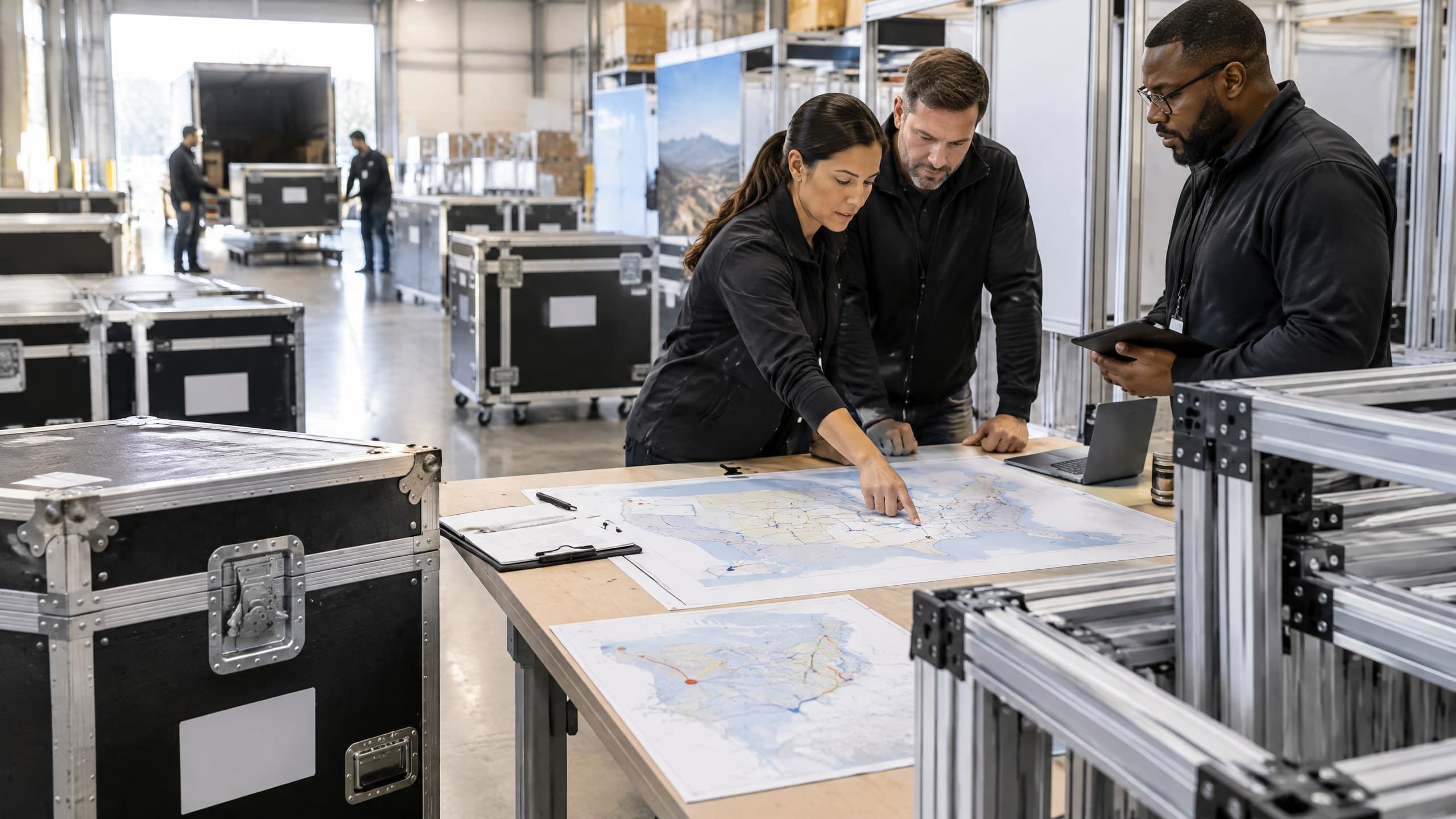
Trade show freight has always had an open secret: competitive bidding produces materially lower prices, and almost nobody does it on every shipment. Not because shippers are lazy, but because a proper competitive round means writing the same specification eleven times, chasing eleven replies, normalising eleven quote formats and comparing them before a deadline. On a big move that is worth a coordinator's afternoon. On a routine four-crate job it never happens, so the work goes to the two or three carriers somebody knows.
That is a workload problem, not a knowledge problem — which is exactly the kind of problem automation is for.
One US exhibit house has been running this for about a month: an automated sourcing system that takes a shipment specification and puts it in front of the entire carrier panel simultaneously, tracks who replied, normalises the answers into a comparable form and flags what is missing. The panel has grown from a handful of familiar names to more than a dozen. Carriers that had been pitching for over a year without ever being given the chance to quote are now in every round.
The results are not subtle. In one competitive round, identical freight on the same lane came back about 25% below the opening number — from the same carrier, in response to nothing more than knowing that others were quoting. That saving did not come from software. It came from competition, which the software simply made cheap enough to run every time.
The part that surprised everyone
The second effect was not the point of the exercise and may end up mattering more.
Running every shipment through the same process builds a dataset. After about forty quoted legs across nine carriers, a pattern appeared that nobody had articulated: dedicated freight leaving Orlando prices at roughly $2.10 a mile, while freight coming into Orlando prices closer to $3.00 — more than 40% higher on the same trucks over the same roads.
The reason is structural. Florida is an outbound freight desert. A truck that delivers into the state struggles to find a paying load out, so carriers price that empty-return risk into every inbound leg. The Pacific Northwest behaves the same way in reverse: freight heading in is expensive, freight coming out is deeply discounted, because trucks want to leave.
None of that is a secret to a freight broker. It was invisible to the exhibit house paying the bills, because you cannot see a pattern in three phone calls. It only appears once somebody is collecting every quote in a comparable form — and having seen it, you can estimate a lane before you ask, know when a number is wrong, and schedule a show program around the direction freight is cheap.
It also sharpens an old decision. If inbound legs to your city carry a structural premium, then renting from inventory already in the show city stops being a preference and becomes arithmetic.
What it does not do
An article about AI in this industry that does not include this section is selling something.
It does not make trucks cheaper. Carriers charge what the lane and the fuel dictate. Every dollar saved in the case above came from competition between suppliers, not from a model.
It does not eliminate the person. Someone still writes the shipment specification, and that specification is where all the domain knowledge lives — advance warehouse rules, piece counts, dock access, what a marshalling yard does to a schedule. The system cannot source those inputs. It fetches, compares, chases and flags. A person awards the load, and the reason they chose a more expensive carrier gets recorded, because sometimes the cheapest quote is the wrong answer and that judgement is worth keeping.
And it gets things wrong. On one lane, the same system produced a cost estimate more than 50% above what the freight actually booked at, because it reached for the wrong shipping mode on a route that rides as a partial load. A human caught it. Anyone deploying this kind of tool and treating its output as an answer rather than a draft will eventually quote a client from a confident, wrong number.
What to ask your suppliers
If AI is being mentioned in a sales conversation, these four questions separate a real capability from a press release.
- What specifically does it do, in one sentence, without the word AI in it? A real answer sounds like "it preflights files on arrival" or "it bids every shipment to fourteen carriers." A vague one is a vague product.
- What changed that I would notice? Faster turnaround, fewer reprints, lower freight quotes. If nothing on the invoice or the calendar moved, it is internal tooling, which is fine — but it is not a reason to choose them.
- Who checks it? Any supplier who cannot name the human review step is describing a risk, not a feature.
- What does it do with my files and my data? Data privacy was the third most-cited barrier to adoption for a reason. Your artwork and your show schedule are commercially sensitive.
The wider point
The gap between 87% adoption and 13% revenue implementation is the whole story of AI in this industry right now, and it is not a failure. It is what early deployment of a general-purpose tool looks like: it goes first to the repetitive, high-volume, low-judgement work, because that is where the arithmetic is obvious and the risk of being wrong is smallest.
In exhibits that means file preparation and freight sourcing before it means anything a visitor to a booth will ever see. The companies getting value from it are not the ones with the most interesting story. They are the ones who pointed it at a boring, expensive, repetitive task and then actually measured what happened.
FAQ
How many exhibition companies are using AI?
87% of exhibition companies report using AI, according to the UFI Global Exhibition Barometer published in early 2026, which surveyed 378 organizers, venues and service providers across 57 countries. That figure was up four points in six months. Roughly half are testing or have implemented AI for process efficiency and customer experience, but only 13% have implemented anything that generates revenue directly.
What is AI actually used for in the trade show industry?
Mostly back-office work rather than anything a visitor sees. Survey data puts data analytics at 20% of usage, personalization at 18%, content creation at 15%, customer service automation at 14%, event logistics at 12%, matchmaking at 10% and security at 5%. The biggest measurable savings so far are turning up in the least glamorous categories — production workflow and freight sourcing.
Can AI make trade show shipping cheaper?
Not directly — AI does not change what a carrier charges per mile. What it changes is how many carriers get asked. Competitive bidding has always produced lower freight prices, but it costs staff time, so most shipments historically went to two or three familiar carriers. Automating the request makes it practical to bid every shipment to a full panel, and the savings come from the competition rather than from the software.
How is AI used in large format printing for trade show graphics?
Chiefly in prepress and production workflow. Tools now shipping automate file preflight, imposition, and the image preparation work that used to be done by hand in Photoshop — brightness, contrast, sharpness and background removal. Others analyze production data to surface recurring faults, or check an installed graphic from a photograph. The common thread is removing manual touchpoints before print, not generating artwork.
Why does freight sourcing matter more in 2026?
Because diesel is at record levels. The US average on-highway diesel price reached $6.285 a gallon in the week ending 14 September 2026, up from $5.599 two weeks earlier — a 69-cent move in a fortnight. Fuel surcharges are indexed pass-throughs, so freight costs rise whether or not anything else changes. Sourcing is one of the few levers an exhibitor still controls.
Disclosure: Trade Show Exhibit News, Exhibit Experience and Factory of Graphics are under common ownership. The freight sourcing system described in this article is operated by Exhibit Experience.
Sources are linked at the point of each claim. If you have a service manual, rate sheet, invoice, or correction, tell the editor.